
Schedules
Server → Automation runs chains of steps on a timer: nightly restarts, hourly save-all, a warning before a restart, a backup before an update. Owners and collaborators with manage can edit them.
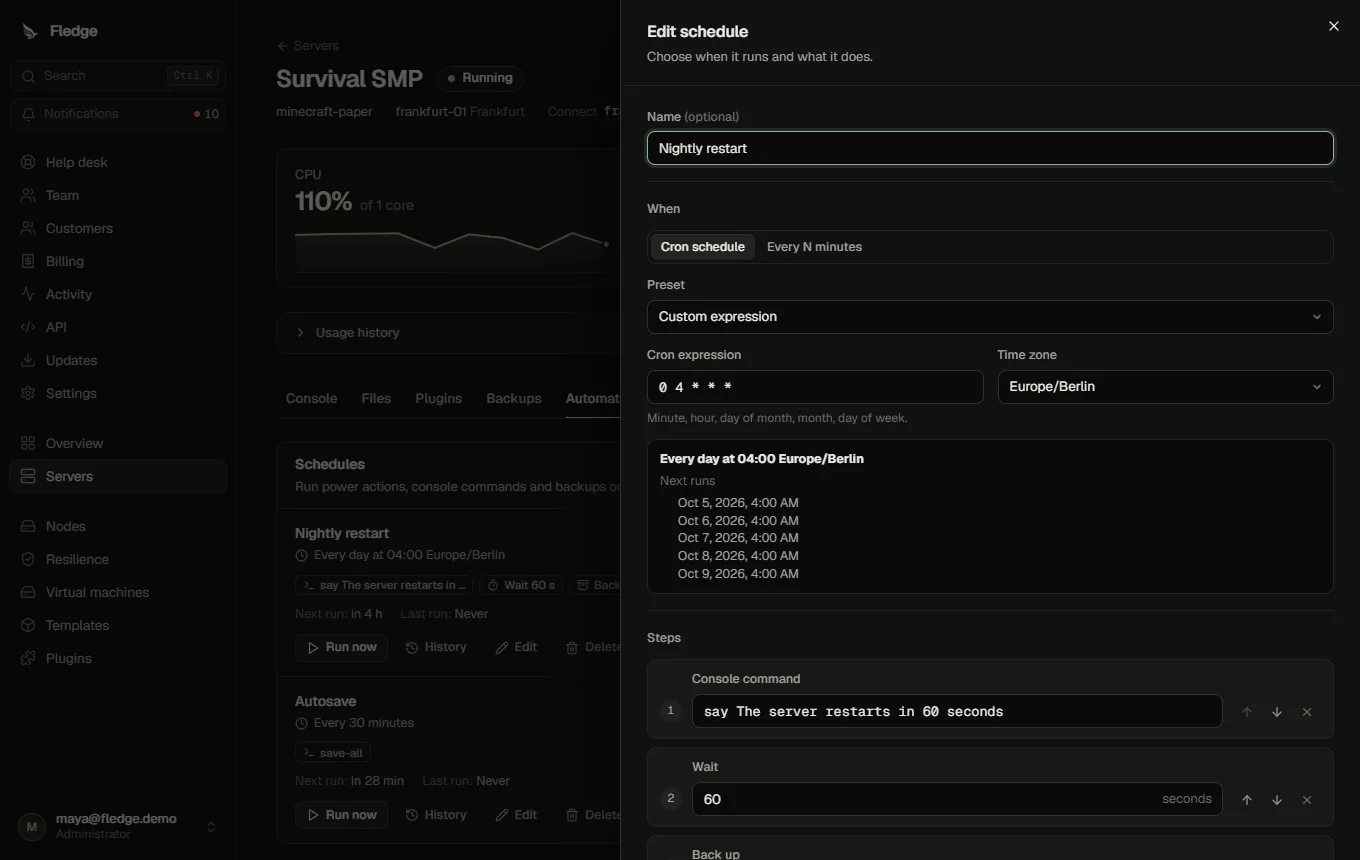
When it runs
| Type | Configuration |
|---|---|
| Cron | A five-field expression (minute hour day-of-month month day-of-week) and a time zone (IANA name such as Europe/Berlin). The editor shows the next five run times. |
| Interval | Every N minutes (minimum 5) |
A schedule can run at most once every five minutes. A server can have up to 20 schedules.
Steps
A schedule is a chain of up to 20 steps that run in order:
| Step | Parameters | Notes |
|---|---|---|
| Command | One line, up to 1024 characters | Sent to the console like a typed command |
| Wait | 1 to 3600 seconds | Waits before the next step; all waits together may add up to 6 hours |
| Backup | none | Takes a backup (needs object storage; counts against the backup quota) |
| Power | start, stop, restart or kill |
Example, a polite nightly restart:
- Command
say Restarting in 60 seconds - Wait
60 - Backup
- Power
restart
Missed runs
If the panel was down at the scheduled time, the schedule's missed policy decides: skip (default; the run is recorded as skipped) or run once when the panel is back. A due run that finds the previous run of the same schedule still in progress is recorded as skipped; a schedule never has two runs at once.
Run now and history
Run now starts a manual run. Every run keeps its history: state, step results, error, trigger (schedule or manual) and times; history is kept for 30 days. A failed step stops the run, marks it failed and raises a schedule.failed notification.
How it executes
Runs are persistent: a run claims its next step with a 90-second lease, so another API process can continue it if one dies. Steps that need the node are queued as jobs and execute in order per server. A step does not wait for the game to finish a command, and a run interrupted by an API crash may repeat its current step.
Stopping from a schedule is not a crash for crash protection.
API: Schedules endpoints.